

DISCLAIMER
The material on this website is provided to the general public and is for informational purposes only. Information contained herein does not reflect the opinion of Paley & Prehn, PLC and should not be relied upon as legal advice. You should consult an attorney for advice regarding your individual situation. Contacting us does not create an attorney-client relationship. Should you wish to hire an attorney at Paley & Prehn, PLC to represent you, you must first sign an agreement for legal services.
The recently passed One Big Beautiful Bill Act (also known as the Big Beautiful Bill) has brought a certain level of clarity to estate planning. For years, individuals and couples with large estates have lived with the uncertainty of whether the historically high estate and generation-skipping tax exemptions—$13.99 million per person in 2025, or $27.98 million for a married couple—would be cut in half at the end of this year. The new law removes the sunset of these exemptions, and beginning January 1, 2026, permanently sets the exemption at $15 million per individual (or $30 million for married couples), with annual inflation adjustments.
You may not agree with every provision of the Bill, but there’s no doubt that eliminating uncertainty about the exemption amount has made estate planning much simpler. During the past two decades of uncertainty in this area, we often prepared disclaimer bypass trusts and other flexible structures so that clients could adapt if the law changed. Those tools were vital when the future was unclear. Now that exemptions have been stabilized, clients with older AB or ABC trust structures may benefit from revisiting their estate plans. In many cases, it may be possible to simplify or even remove restrictive provisions that are no longer necessary.
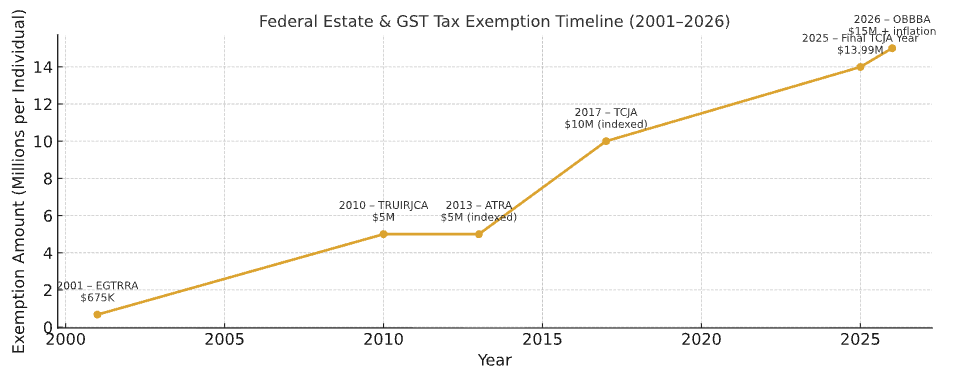
Figure: Federal estate, and GST tax exemption amounts, 2001–2026, with major legislative milestones including EGTRRA, TRUIRJCA, ATRA, TCJA, and OBBBA (One Big Beautiful Bill Act).
A Short History of Estate Tax “Sunsets”
For more than two decades, estate planners have had to work around temporary rules and looming expiration dates:
2001 – EGTRRA (Bush Tax Cuts):
Raised the exemption gradually from $675,000 to $3.5M (by 2009), repealed the estate tax for 2010, but set all provisions to expire 12/31/2010.
2010–2012 – TRUIRJCA:
Reinstated the estate tax with a $5M exemption (indexed for inflation) and introduced portability — but only through 2012.
2013 – ATRA (Obama Era):
Made the $5M (indexed for inflation) exemption and portability permanent, with a 40% top tax rate.
2017 – TCJA (Trump Era):
Doubled the exemption (to $10M + inflation) but scheduled a sunset for 12/31/2025, returning exemptions to pre-2018 levels.
2025 – One Big Beautiful Bill Act:
Removes the TCJA sunset and, starting January 1, 2026, sets the unified exemption at $15M per individual ($30M per couple), indexed annually for inflation — finally providing long-term stability.
Lifetime Gifts
Keep in mind that the annual gift tax exclusion is currently $19,000 per recipient each year (or $38,000 per recipient for married couples splitting gifts). You can give this amount in 2025 without using any of your lifetime exemption. What this means is that a married couple with three children, for example, can give each child $38,000 in 2025. This exclusion is indexed annually for inflation, so it is expected to increase again in 2026.
Charitable Bequests
The Big Beautiful Bill does not change the rules for charitable bequests at death. Gifts to qualified charities — including donor-advised funds — remain fully deductible for estate tax purposes. We will cover the new rules for lifetime charitable giving, including the 0.5% AGI floor and deduction caps, in a separate post.
Now Is the Time to Review Your Estate Plan
Although high exemptions create opportunities to preserve family wealth, every family is different and your estate plan should reflect your specific needs. At Paley & Prehn, we don’t just prepare documents—we build comprehensive plans that evolve with you. Now is the perfect time to review your estate plan with us to make sure it takes full advantage of today’s favorable rules while protecting what matters most to you.