

DISCLAIMER
The material on this website is provided to the general public and is for informational purposes only. Information contained herein does not reflect the opinion of Paley & Prehn, PLC and should not be relied upon as legal advice. You should consult an attorney for advice regarding your individual situation. Contacting us does not create an attorney-client relationship. Should you wish to hire an attorney at Paley & Prehn, PLC to represent you, you must first sign an agreement for legal services.
Even if you don’t owe gift taxes, you might still need to file a gift tax return – and the IRS may impose penalties for failure to file even if no taxes are due.
The IRS Form 709, officially known as the United States Gift (and Generation-Skipping Transfer) Tax Return, is a mandatory filing for individuals who have made gifts exceeding a certain threshold during a calendar year. In this blog post, we’ll delve into the purpose of Form 709, its filing requirements, the concept of split gifts, and, most importantly, the severe consequences of failing to file this often-ignored tax return on time.
What is Form 709?
Form 709 is designed to track and report gifts that individuals make during the year. The purpose is twofold:
Gift Tax Assessment
The primary function of Form 709 is to calculate and assess any gift tax owed to the IRS. While the majority of individuals won’t owe any gift tax due to generous exemptions, it is essential to report gifts accurately.
Generation-Skipping Transfer Tax
Form 709 is used to report generation-skipping transfers. This tax applies when assets are transferred to someone who is more than one generation or 37.5 years younger than the donor (such as a grandchild).
How do I know if I need to file a gift tax return?
You must file Form 709 if you have given gifts to someone (“donee”) that exceed the annual gift tax exclusion. If your gift was lower than the exclusion amount, you do not need to report the gift. The exclusion amount has increased incrementally over the years:
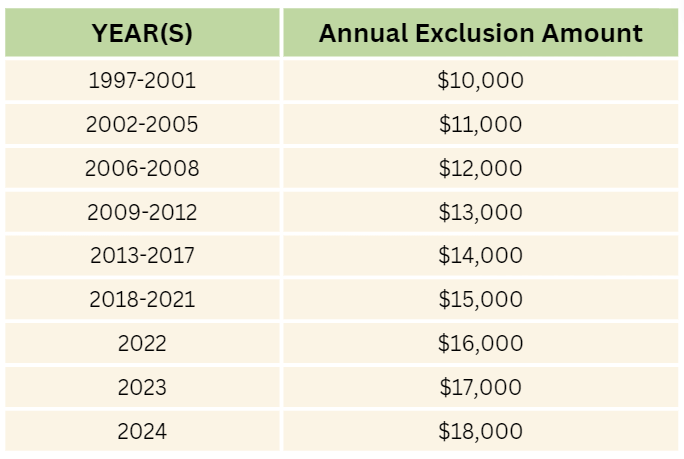
As long as your gifts are below the threshold, you can make gifts to any number of people each year. There is no annual or lifetime limit. In other words, if you have three children and give each of them $18,000 this year (2024), the annual exclusion will apply to each one of those gifts, for a total of $54,000 in non-taxable gifts that you can make to your children this year. And next year you can do the same.
What if my spouse and I both make the gift?
If you are married, you and your spouse can “split” a gift and in effect double the annual exclusion amount – meaning that each of you will be able to gift $18,000 to your donee, for a total of $36,000 this year per person, with no tax consequences. In this case, each spouse must file a separate Form 709, even if the total gift doesn’t exceed the annual exclusion. This will ensure that both spouses’ exemptions are utilized.
What can I exclude from my reportable gifts?
Some gifts that are over the annual exclusion amount may also be exempt from tax. These include the following:
- Tuition payments for someone else
- Medical payments for someone else
- Gifts you make to your spouse (the gift tax “marital deduction”)
- Gifts you make to a political organization
- Gifts to qualifying charities (e.g., nonprofit organizations with 501(c)(3) status)
Note that some of these gifts may be subject to other limitations and you should review the numbers with your CPA or tax attorney prior to distribution.

Consequences of Not Filing on Time
Failing to file Form 709 on time can have serious repercussions:
Penalties
While penalties generally accrue based on the amount of tax owed and the length of the delay, the IRS may impose penalties for late filing even if no taxes were due!
Underreporting
If you don’t file, the IRS won’t have accurate information about your gifts. This could lead to underreporting, which may result in further penalties or audits.
Missed Exemptions
By not filing, you risk missing out on valuable gift tax exemptions that could reduce or eliminate your gift tax liability. For example, you generally cannot retroactively split a gift with your spouse if they have since passed away.
Legal Troubles
In extreme cases, failure to file and pay gift tax can lead to legal troubles, including tax evasion charges.
Filing Form 709 on time is not just a tax obligation but a prudent step to avoid potential financial and legal consequences.
How Paley & Prehn Can Help You
The estate planning and tax attorneys at Paley & Prehn, PLC can help you make sure that you are in compliance with IRS regulations and provide guidance for your gift-giving. Contact our office to learn more.